

I built markdown.new and it went a little viral on X
I immediately integrated it as the primary tier in markdown.new's conversion pipeline. Two days later, on February 14, I shipped the updated version and posted about it on X. By end of day the tweet had nearly a million views, 4.2K likes, and 5.4K bookmarks.


markdown.new/ before any URL. Get clean, AI-ready Markdown back. That's the whole pitch. 960K views later, I guess it resonated.I actually built the first version of markdown.new about a year ago. The problem was obvious: AI pipelines were choking on raw HTML, and every team building RAG systems was writing the same boilerplate — Puppeteer for rendering, BeautifulSoup for stripping, custom regex for cleanup, separate handlers for PDFs. I wanted a single URL prepend to collapse all of that.
I built https://t.co/TegRO9wVZF
— Emre Elbeyoglu (@elbeyoglu) February 14, 2026
Put https://t.co/aJjJVn3uHO before any URL → get clean Markdown back.
Cloudflare's Markdown for Agents is great, but only works for enabled sites. https://t.co/TegRO9wVZF works for ANY website on the internet.
80% fewer tokens. Also converts… https://t.co/ZfWGOLRUyN
It worked, people used it, but it didn't exactly take the internet by storm.

Then on February 12, 2026, Cloudflare announced Markdown for Agents — a native feature that lets AI agents request Markdown directly from any Cloudflare-enabled site using a simple Accept: text/markdown header. The network converts HTML to Markdown at the edge, on the fly, and returns it with token count estimates in the response headers. No extra tooling needed on the client side.
It was exactly the infrastructure-level solution the problem deserved. I immediately integrated it as the primary tier in markdown.new's conversion pipeline. Two days later, on February 14, I shipped the updated version and posted about it on X. By end of day the tweet had nearly a million views, 4.2K likes, and 5.4K bookmarks.
Sometimes you build the right thing a year too early. Then the ecosystem catches up, and suddenly it all clicks.
What does it actually do?
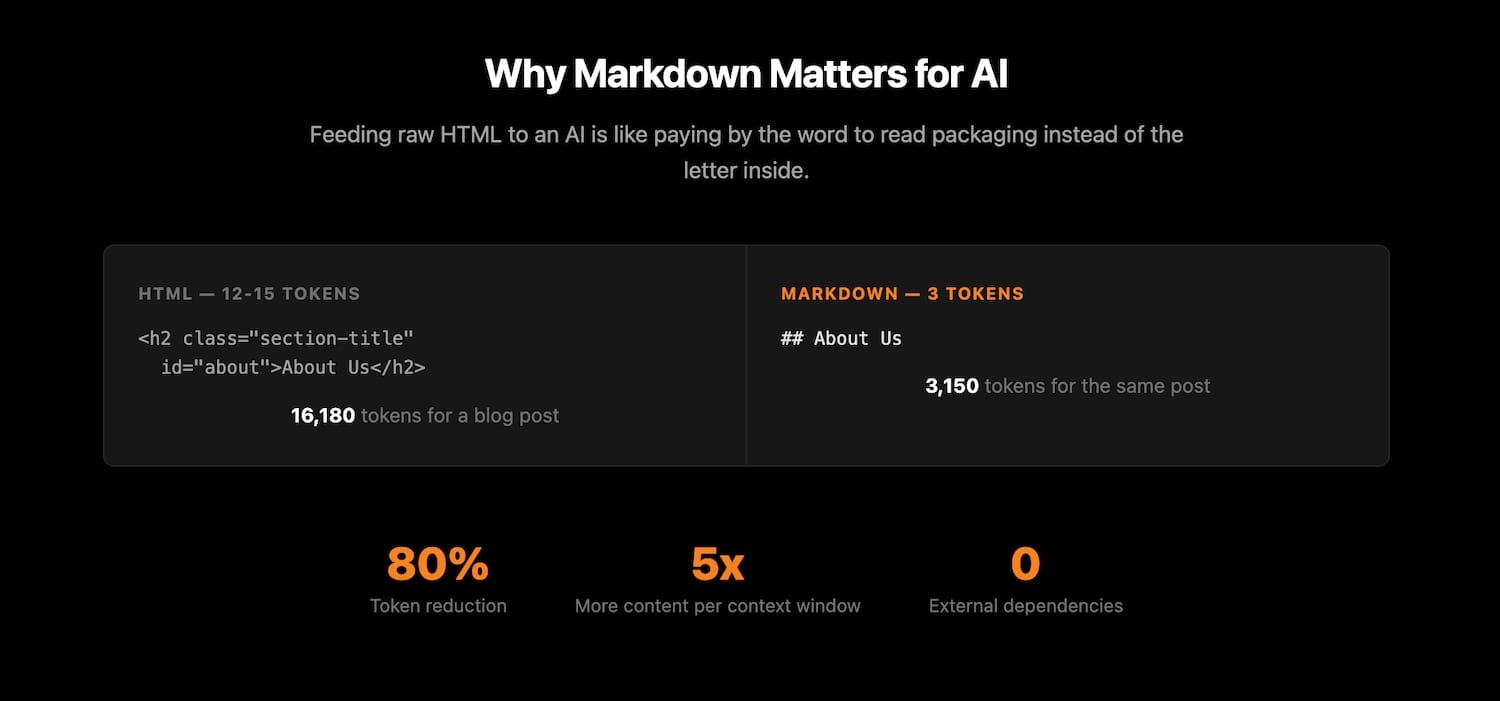
The web was built for browsers, not for AI agents. Every page you fetch is wrapped in navigation bars, script tags, CSS classes, and div soup. Cloudflare did the math: a simple <h2 class="section-title">About Us</h2> costs 12–15 tokens. The Markdown equivalent? 3 tokens. That's an 80% reduction in token usage.
markdown.new solves this for any URL on the internet — not just Cloudflare-enabled sites. You prepend it to any address:
https://markdown.new/https://example.com/any-page
No API key. No signup. No configuration.
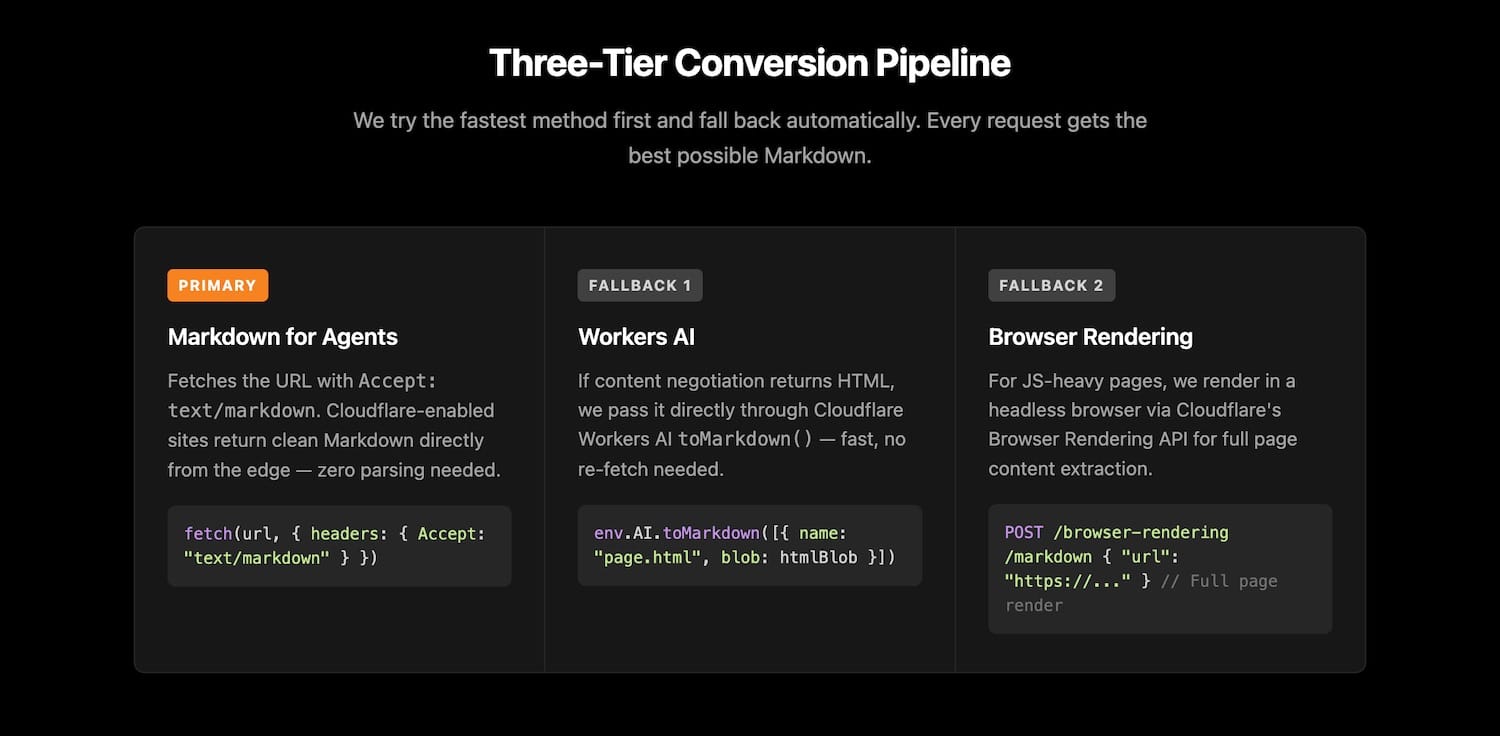
It uses a three-tier fallback system under the hood:
- Content Negotiation — If the target site supports Cloudflare's Markdown for Agents, you get native Markdown straight from the edge. Fastest path.
- Workers AI toMarkdown — If the site returns plain HTML, it gets piped through Cloudflare's AI conversion layer on the spot. No second fetch needed.
- Browser Rendering — For JavaScript-heavy SPAs where the HTML is just a shell, a headless browser renders the page first. Slower, but it works for everything.
Beyond URLs, the web interface also handles file uploads: PDFs, Word docs, Excel sheets, PowerPoint files, images (OCR), and audio (transcription). One tool for everything I kept reaching for in my own agent pipelines.
Why it landed when it did
Timing mattered. Two days before I shipped, Cloudflare announced Markdown for Agents — a feature that lets AI agents request Markdown directly from websites via Accept: text/markdown headers. It's a real signal that the web is starting to treat agents as first-class citizens.
But Cloudflare's feature only works on sites that have opted in (Pro plan and above). Most of the web hasn't. markdown.new fills that gap — it takes advantage of native support when it's available and handles everything else itself.
What people said
The replies were the most interesting part. A few that stuck with me:
"I put this in my system prompt so AIs can access websites they currently can't." — @faint6005
"Is there an API?" — @HunnaFresh (yes — just call it programmatically, no key needed)
"Short-term workaround until sites add text/markdown natively?" — @gbigot (probably, but that could take years)
"How is it free though?" — @gonzalo_bruna (Cloudflare Workers free tier goes a long way... for now)
"Doesn't fetch when I use Https instead of https" — @ziperke (fixed — URL normalization now handled)
The prompt injection concern from @clarity99 is worth taking seriously. If you're piping externally-fetched Markdown directly into an LLM, malicious pages could embed instructions. It's not a markdown.new-specific problem — it's a general risk with any web-fetching agent tool — but worth building sanitization into your pipelines.
What's next
Shipping something people actually use is the best kind of feedback loop. Twenty-four hours of real traffic surfaced more edge cases than months of solo testing would have. PDF support needs work. The API question came up enough that I'll document it properly. Open-sourcing is on the table.
For now: try it. Take any URL, prepend markdown.new/, and see what comes back.
https://markdown.new/https://blog.cloudflare.com/markdown-for-agents/
The web was built for browsers. Markdown is built for agents. markdown.new is the bridge between where the web is today and where it's going.
I write about building AI tools and growth at growthmarketing.ai. Follow me on X at @elbeyoglu.


